Tools of the Trade: Essential Accessories
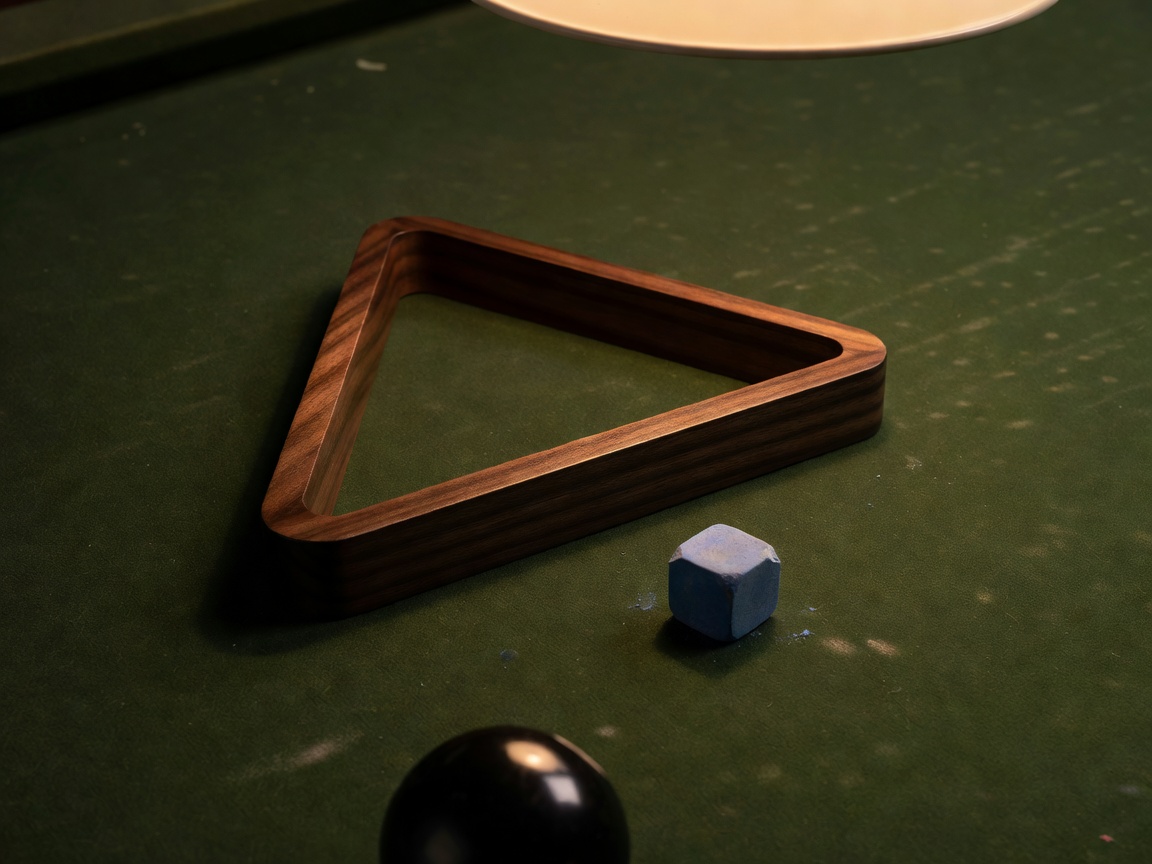
While the cue and the table form the foundational core of billiards, secondary accessories heavily dictate the quality and consistency of play. Proper maintenance tools, gripping aids, and racking mechanics are non-negotiable for anyone looking to eliminate variance from their game. Here, we evaluate the essential accessories that deserve a place in every serious player's cue case.
Chalk: The Grip Interface
Chalk is fundamentally an abrasive, designed to create friction between the leather cue tip and the phenolic resin of the cue ball. Without chalk, applying off-center spin (English) results in a miscue—the tip slipping off the ball, leading to a catastrophic missed shot. Not all chalk is created equal. Standard commercial chalk is highly powdery, requires application before every shot, and leaves significant residue on the table cloth.
Premium chalks are formulated with finer abrasives and higher moisture contents, allowing them to bind to the leather tip more securely. Some elite variants can endure multiple heavy-spin shots without needing reapplication and leave minimal particulate dust, thereby extending the life of the table's worsted cloth.
Racking Logistics: Triangles vs Templates
A tight rack is the prerequisite for a fair and explosive break. Traditional wooden or plastic triangles have been used for decades, but they suffer from inherent flaws: warping over time, inconsistencies in construction, and an inability to compensate for uneven table wear at the foot spot.
The modern solution is the template rack. Made from hyper-thin plastic films with precision-cut holes, a template rack locks the balls tightly together by allowing them to rest slightly in the cutouts. This guarantees ball-to-ball contact across the entire rack, meaning the kinetic energy from the break is transferred perfectly through the cluster rather than being lost to dead gaps. The result is a much wider, more predictable spread.
Mechanical Bridges and Extensions
Given the dimensions of standard tables, players inevitably face shots where they cannot comfortably reach the cue ball. Instead of risking a foul or compromising mechanics by overstretching, players use a mechanical bridge (often referred to as a "rest"). Traditional bridges include the cross head (standard), the spider (elevated to shoot over obstructing balls), and the swan neck.
Modern players also increasingly rely on cue extensions—lightweight carbon fiber tubes that screw into the bumper of the cue butt, instantly adding 6 to 12 inches of length. Extensions allow the player to maintain their natural, stable stroke on long reach shots without relying on the somewhat cumbersome mechanical bridge.
Gloves and Maintenance Tools
Billiard gloves, typically constructed from low-friction lycra or spandex, slide over the bridge hand. They eliminate the effects of humidity and hand sweat, guaranteeing that the wooden shaft glides smoothly during the stroke. For players who eschew gloves, hand talc is used, though it creates a mess.
Finally, tip tools—such as scuffers, shapers, and burnishers—are vital for maintaining the equipment. A scuffer roughs up a glazed tip to hold chalk, a shaper maintains a perfect nickel or dime radius, and a burnisher hardens the side walls of the leather to prevent mushrooming. Together, these tools ensure that every strike is identical in feel and friction.