Mastering the Run: 8-Ball Strategy
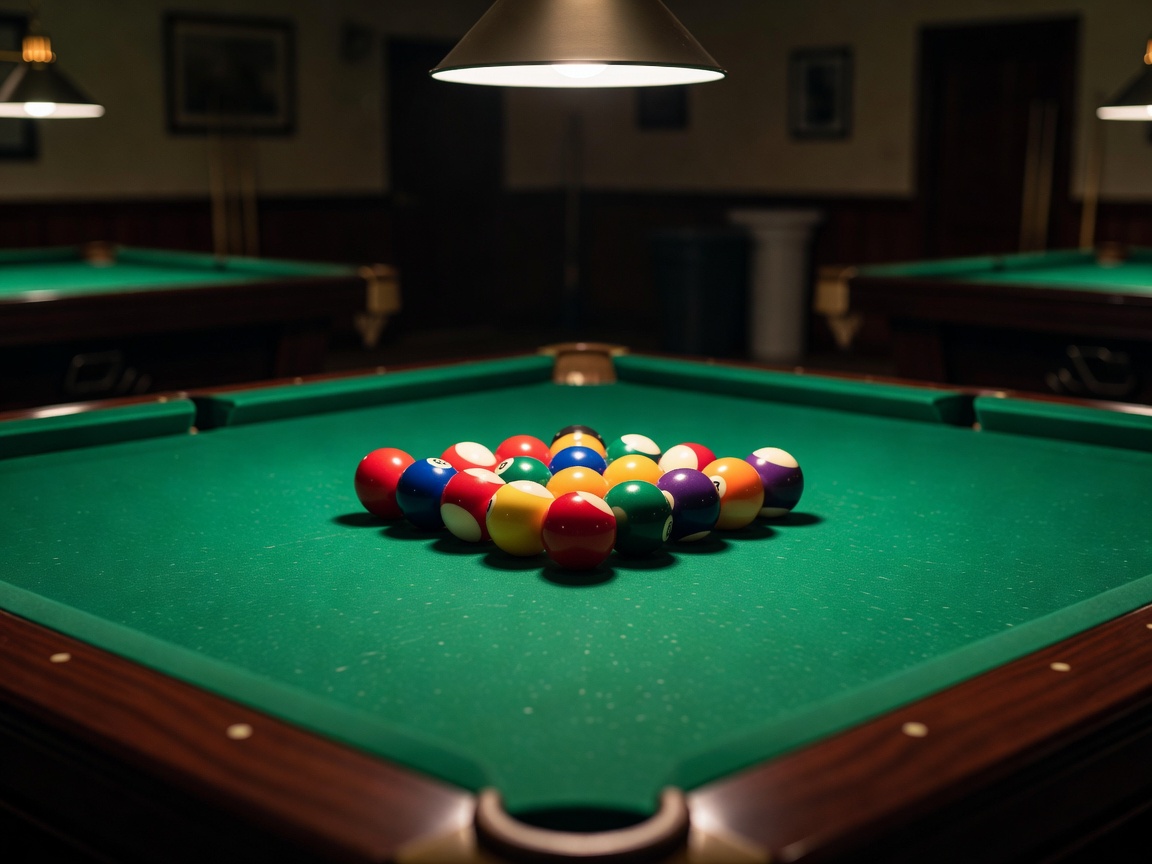
Eight-ball is structurally unique among cue sports. Because a player is restricted to legally pocketing only half the object balls on the table (solids or stripes) while avoiding the 8-ball until the end, the table effectively becomes a crowded minefield. Success in 8-ball is less about sheer shot-making ability and entirely reliant on cognitive planning, pattern mapping, and precise cue ball control.
The Break and Table Assessment
The objective of the break in 8-ball is not merely to scatter the balls, but to pocket a ball while leaving the cue ball in the center of the table (the "kitchen" or center diamond area). Squatting the cue ball in the center provides maximum visual access to the resulting layout. Hitting the lead ball squarely with a slightly below-center stroke (draw) forces the cue ball to stop dead in its tracks after transferring its momentum.
Once the break is complete, novice players immediately scan for the easiest pocketable ball. Advanced players do not shoot right away. They undertake a process known as "mapping." This involves identifying which suit (solids or stripes) offers a viable path to run all seven balls and finish on the 8-ball. The assessment looks for problem areas: tied-up clusters, balls sitting on rails, or balls blocked by the opponent’s suit. If a problem cannot be solved during the run, attempting a run-out is fundamentally flawed.
Positional Play and Tangent Lines
Controlling the cue ball dictates the rhythm of the game. Positional play is governed by the tangent line—the 90-degree axis the cue ball travels along after striking an object ball (when sliding with no top or bottom spin). Understanding this geometric truth allows players to weave the cue ball through traffic.
- Follow (Top Spin): Causes the cue ball to curve forward of the tangent line. Useful for tracking the cue ball up the rail.
- Draw (Bottom Spin): Causes the cue ball to pull back behind the tangent line. Essential for reversing direction in tight spaces.
- Stun: Hitting the cue ball with just enough bottom spin so it is sliding exactly at the moment of impact, forcing it to travel precisely down the tangent line.
The goal is always to leave an angle on the next shot. Leaving the cue ball perfectly straight in on an object ball restricts movement, as the only natural path is straight forward or straight back. Having an angle allows the cue ball to travel naturally across the table to set up the subsequent shot.
Safety Play and Two-Way Shots
When an offensive run-out is mathematically impossible due to a cluster or a blocked path, the correct strategic choice is a safety. A safety is a shot deliberately played to leave the opponent in a disadvantageous position, ideally forcing them to commit a foul (giving you ball-in-hand) or leaving an open table upon their miss.
Effective safeties in 8-ball often involve hiding the cue ball behind your own suit or distance control (leaving the cue ball frozen to a short rail while the object ball is at the opposite end). Advanced players employ "two-way shots"—attempts that aggressively target a pocket but are struck at a speed that ensures if the ball misses, the cue ball lands in a safe zone.
In conclusion, 8-ball is a game of problem-solving. By prioritizing table mapping before the first shot, maintaining precise angles through cue ball control, and respecting the strategic necessity of safety play, players can systematically dismantle their opponents rather than relying on desperate heroics.